
Midvale City Directory Collections
The strongest Midvale city directory lead is the University of Utah Digital Collections shelf for R. L. Polk Salt Lake City volumes that include suburbs. Documented volumes include 1919, 1924 through 1926, 1932, and 1935. The 1932 description includes a complete alphabetical directory, officers, map, classified business section, street and householders directory, and buyers guide. The 1935 description adds business and private citizens, office occupants, a street and avenue guide, and buyers guide.
| Collection | Years | Where Held | Access |
|---|---|---|---|
| R. L. Polk volumes | 1919; 1924–1926; 1932; 1935 leads | University of Utah / UHS | Digitized pages and PDFs |
| Address or criss-cross sections | Especially useful after 1924 | UHS directory guidance | Use street and householder sections |
| Telephone directory | 1931–1932 cataloged | FamilySearch catalog 1402678 | Catalog or library access varies |
| Gazetteer and business runs | 1900–1931 catalog runs | FamilySearch catalog 134049 | Microfilm or catalog access varies |
| Newspapers and maps | 1777–1963 newspapers; 1867–1970 Sanborn coverage | County Library, City Library, UHS | Searchable or in-person by collection |
No official source established the first or last Midvale-specific printed year, and the library pages do not publish a complete branch-level shelf list. Treat the documented runs as research leads, not a complete series. A missing year may require a library call, a microfilm visit, or a search of the holding institution’s catalog.
University of Utah’s Midvale Volumes
The digitized collection is valuable because Midvale can be tucked inside a Salt Lake City title. Search the volume record, then inspect the alphabetical, street, householders, classified, and buyers-guide sections. The 1924, 1925, and 1926 descriptions explicitly include Murray, Midvale, Sandy, Garfield, and suburbs. The 1932 volume includes Midvale along with Murray, Sandy, Magna, and Garfield suburbs.
The University of Utah page for the 1919 material also preserves a street-system explanation. It helps decode period address grids before an old street is compared with a modern parcel. Do not treat an OCR hit for Midvale as proof of a person’s address. Open the page, note the publication year and section, and transcribe the entry as printed.
The University of Utah digitized directory collection shows where the searchable volumes live.
A scan is a period source. Pair its street wording with a map, deed, tax card, or newspaper before converting it to a present-day address.
Reading a Midvale City Directory Entry
A Midvale city directory entry compresses several clues into a short line. The name may be followed by an occupation, a spouse or widow notation, a street address, and a mark that shows residence or boarding. The entry describes the book’s publication moment. It does not promise that a person stayed at that address for the whole year or that every household member was listed.
| Name | Often the head of household; spouse or status may follow. |
|---|---|
| Occupation | A period role or business connection, read as printed. |
| Address | House number and street; “r” means residence and “b” means boards in the inspected context. |
| Room notation | “rms” means rooms in the inspected abbreviation context. |
| Status mark | “wid” means widow; confirm each volume’s own legend. |
- Criss-cross section
- A street-order or address section that reverses the usual name-first search.
- Householder index
- The geographic list of people or households arranged by street and address.
- Abbreviation key
- The volume’s legend for short marks such as r, rms, wid, lab, constr, and slsmn.
Midvale’s Library and Newspaper Shelf
Salt Lake County Library’s genealogy page points researchers to Utah Digital Newspapers, Utah NewsSearch, Chronicling America, maps, federal census material, and other local-history databases. Utah NewsSearch can filter by newspaper, city, county, and ZIP. Search Midvale with Union, Bingham Junction, Jordan Bluffs, Fort Union, a street name, a surname, or initials. Obituaries, marriage notices, births, legal notices, school activities, and organization news often fill a gap between directory years.
The City Library Archives adds newspapers on microfilm, local-history books, photographs, maps, ephemera, scrapbooks, pamphlets, and Masonic Library Records. It is a regional Salt Lake City resource, not a Midvale municipal archive, and its in-person tools include scanners and microfilm readers. The county library does not publish a complete Midvale branch directory shelf, so verify holdings before promising a particular volume.
The Salt Lake County Library genealogy route is the best regional starting map for newspaper and family-history databases.
Library databases and regional archives are companion sources. A newspaper hit can suggest a date or relationship, while the directory supplies a street clue.
Midvale’s Pink Pages Shortcut
Utah Historical Society guidance says Polk city directories become especially useful after 1924, when the address section, often called the pink pages, is arranged by address and name. Start there when the house is known. Then move to the alphabetical section for occupation, status, or spelling clues. This reverse route is the practical criss-cross method documented for the regional collection, not a separate Midvale database.
Before 1924, the research path leans more on newspapers, county Recorder and Assessor material, maps, and Archives. The UHS Research Center can search spelling variants and alternate terms or refer a question to another repository. Its current listing gives 7292 S State St, Midvale, Utah 84047-2007 and 801-245-7227. Confirm visit instructions through the Utah Historical Society collections page.
Midvale Cemetery and Identity Clues
Utah State History’s cemetery search accepts first name, last name, death-year range, cemetery, county, and city. FamilySearch also has a Midvale City Cemetery page. These searches can separate two people with the same name and lead to an obituary or family record. A burial record can verify death and place, but it does not prove that someone lived at a particular Midvale address before death.
A local history lead describes an older Pioneer or Indian Burial Ground near the smelter and behind smelter homes on North Holden, alongside the present Locust Street cemetery. Treat that description as a clue to verify in the original history item, city cemetery rules, archive material, and the official search database.
The Utah State History cemetery search shows the name and place fields available for a bounded identity check.
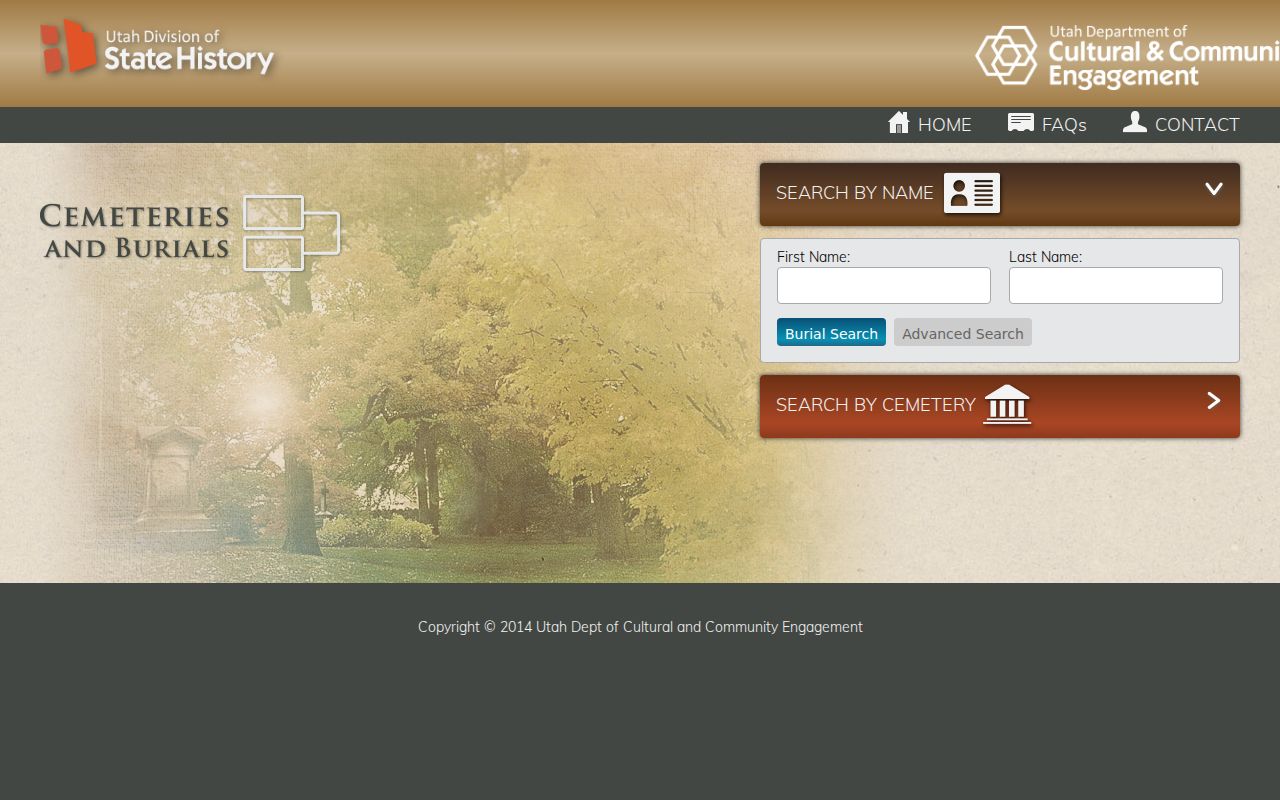
Use the death-year and cemetery filters to narrow a name. Keep the result tied to its source and avoid turning a burial lead into a complete family profile.
Why Midvale Names Shift
Midvale’s record language reflects settlement and change. Union Fort was established in 1853, Main Street and Bingham Junction grew with mining and rail activity, and Midvale incorporated in 1909. Union’s 1998 annexation changed the modern boundary. A person can therefore appear under Union, Union Fort, Bingham Junction, a Salt Lake City suburb label, or Midvale depending on the year and source.
Use the original locality and publication year in a research note. Then compare the directory’s street guide with County Archives maps, Sanborn sheets, a recorded plat, and a current parcel legal description. A city directory is strongest when its name and address agree with another dated record.
Midvale Directory Timeline
| 1919 | Digitized Salt Lake City directory pages show Midvale references and a street-system explanation. |
|---|---|
| 1924–1926 | R. L. Polk volumes explicitly include Midvale and other Salt Lake Valley suburbs. |
| 1931–1932 | FamilySearch catalogs a telephone directory for Salt Lake City and adjoining towns including Midvale. |
| 1932 | The volume description includes alphabetical, street, householders, classified, map, and buyers-guide sections. |
| 1935 | The description adds private citizens, office occupants, street and avenue guide, and buyers guide. |
This is a documented research timeline, not a claim that these are the only surviving years. The first and last Midvale-specific printed years were not established. Verify missing years with the holding institution.
Midvale History in Search Terms
Local history can improve a city directory search without inventing a resident story. Union Fort, Bingham Junction, Main Street, smelter, railroad, hotel, school, and church are useful terms for the Salt Lake Valley’s earlier record language. Mexican Migration Stories held by Utah historical institutions adds a human-use lead for research into Mexican families connected with Bingham Canyon mining and later Midvale community life. Search the original institution, place, and time terms in newspapers and directories.
Use the words as search keys, not as proof of an address. A business or church mention may place a person in a public role without identifying a household. Match the directory page to a street guide, map, obituary, or tax card before treating it as a family-history fact.
Using Midvale City Directories for Family History
Use a city directory as a dated layer in a family or house history. Follow the name across the documented volumes, note every address change, and pair directory years with census years rather than treating either source as complete. Newspapers can explain a move, marriage, death, organization role, or business change. Tax cards and deeds can test whether the same address remained the same parcel.
- Find the first appearance in the alphabetical or householders section and copy the line as printed.
- Follow the name through the 1919, 1924–1926, 1932, and 1935 leads, recording street and status changes.
- Use the street or pink-pages section to test the address and nearby entries.
- Pair each directory period with census, newspaper, tax-card, map, or deed evidence.
- Use the cemetery and vital-record routes only for a permitted life-event check, then record the negative or missing result.
Disappearing from a directory can mean a move, death, an unlisted telephone, a spelling change, a publication gap, a boarding-house convention, or an address outside the volume. It is not a negative finding by itself. Write “not located in the searched volume” and test the next section or source.