
Sources for Previous Residents at One Address
The best previous residents trail starts with the current APN and legal description, then works backward through records held by different custodians. Salt Lake County Recorder indexes show instruments and parties. County Archives tax cards and ledgers add building and assessment snapshots. Polk city directories and telephone catalogs can place people at a published address. Maps and Sanborn sheets help translate streets, while newspapers, cemetery, and vital sources test dates and identity.
| Source | Years It Covers | Where Held | What It Shows |
|---|---|---|---|
| Recorder person index | 1986–present described | Salt Lake County RecorderWorks | Recorded document parties and dates |
| Recorder APN deeds | March 3, 1997–present described | County Data Services | Deeds tied to a parcel |
| Land-title certificates | 1851–1895; bulk 1871–1873 | County Archives | Early name and legal-description trail |
| Tax ledgers and cards | 1853–2021 ledgers; cards 1934–1991 ranges | County Archives and Treasurer | Assessment, owner, building, and address snapshots |
| Polk and telephone directories | 1919; 1924–1926; 1932; 1935; phone 1931–1932 | University of Utah, UHS, FamilySearch | Dated names, streets, households, and subscribers |
Use RecorderWorks for the recent deed chain, Archives for early title or tax material, and the city directory collections for occupants. No official source established a complete Midvale series or a complete address-equivalence table. Treat every result as a dated layer, not as proof of continuous residence.
Midvale’s County House-History Files
Salt Lake County Property and House History is the local bridge between a modern address and older occupants. The Archives guide lists tax cards, permits, maps, photographs, ledgers, and land-title certificates. The tax-card search uses an address or tax parcel number and automatically adds dashes. The card may show owner or address, building type, stories, additions, square footage, year built, depreciation, garage, appraisal date, and footprint.
The card set is incomplete. The documented ranges cover 1934 through 1987 or 1991, with online portions still uneven. Earlier or missing cards may require Archives contact at 385-468-0820. Save the current APN before asking. A card’s owner, mail-to, building, and assessment fields must stay distinct from an occupant listed in a directory.
The Salt Lake County house-history guide identifies the local records trail.
The guide points toward records that can explain a building without guessing who lived there between two dated entries.
Tracing Past Owners Through the Salt Lake County Deed Chain
Ownership research begins with the current Assessor parcel and legal description. Recorder Data Services describes owner-of-record, tract, chain-of-title, legal-description, document, and plat searches. RecorderWorks supplies name, APN, date, type, book/page, document-number, and legal-description modes. The person index is described from 1986 to the present, while APN deed searching is described from March 3, 1997 to the present. Older title material moves into Archives.
- Save the current owner string, APN, situs address, and legal description from Assessor or GIS.
- Search the Recorder by selected address or APN, then note document number, date, type, parties, and image status.
- Use the latest grantee and prior grantor as names for the next backward search.
- Carry the legal description and plat reference across each step instead of trusting a modern street label.
- Move to abstracts, grantor and grantee indexes, plats, or Archives when online coverage ends.
- Grantor / grantee
- The grantor transfers an interest; the grantee receives it.
- Chain of title
- The linked sequence of recorded interests that connects a parcel through earlier instruments.
- Legal description
- The recorded land description, such as lot, block, plat, or section terms, used when street names change.
Tax Cards and Changed Midvale Streets
Tax cards can identify a house when an address has shifted. The research notes assessment dates such as 1936, 1957, 1964, and 1980, plus building details, photos, additions, garages, and depreciation. The county’s 1853 to 2021 tax ledgers add a longer account trail, with 1853 through 1870 online and later questions routed through Archives or the Treasurer.
Official sources did not document a complete Midvale street-renumbering year or renamed-street table. Compare the 1919 Polk street-system page, a County Archives map or plat, and the current APN and legal description. Historic labels such as Union, Union Fort, Main Street, and Bingham Junction should be kept beside, not silently replaced by, modern Midvale.
The County tax appraisal-card search explains its address and parcel route.
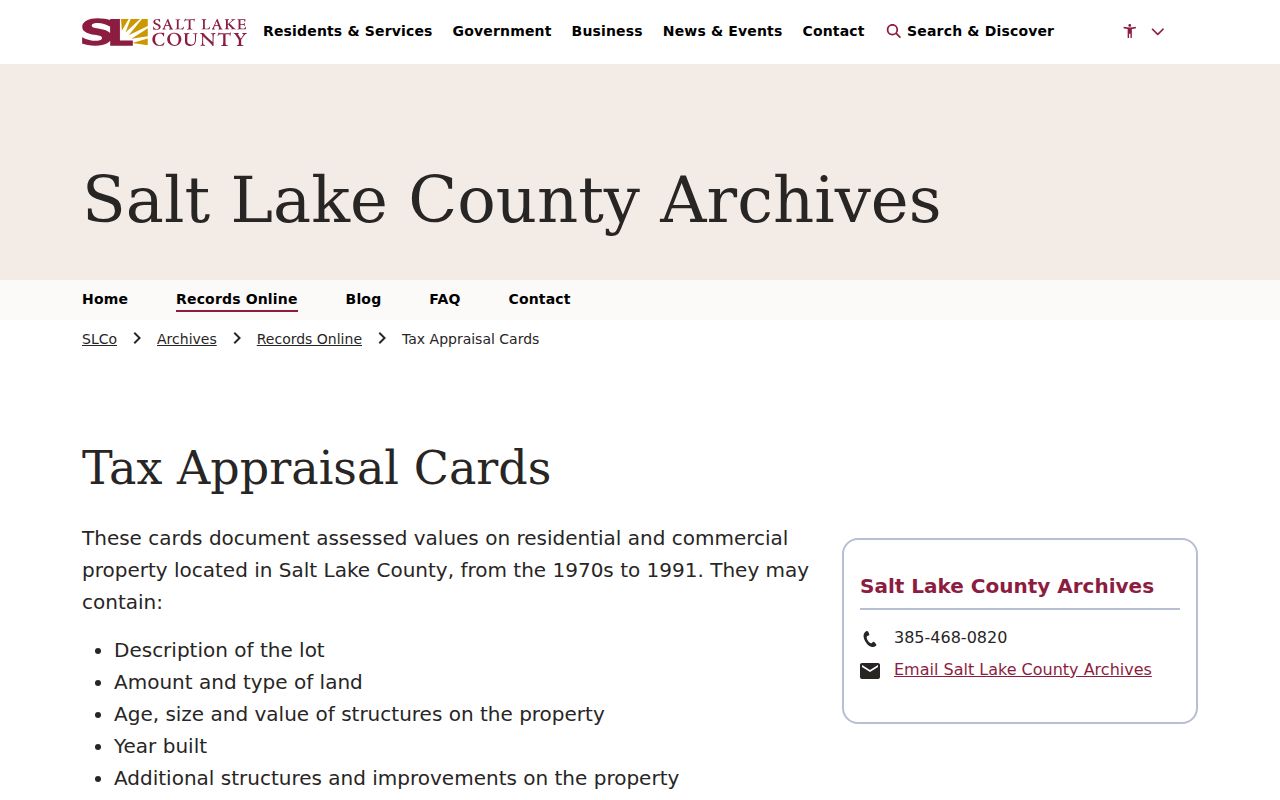
An address search is the bridge. The resulting card date and field labels decide what can be said about the property or a past owner.
The County Archives tax-card search also exposes the address and parcel route.
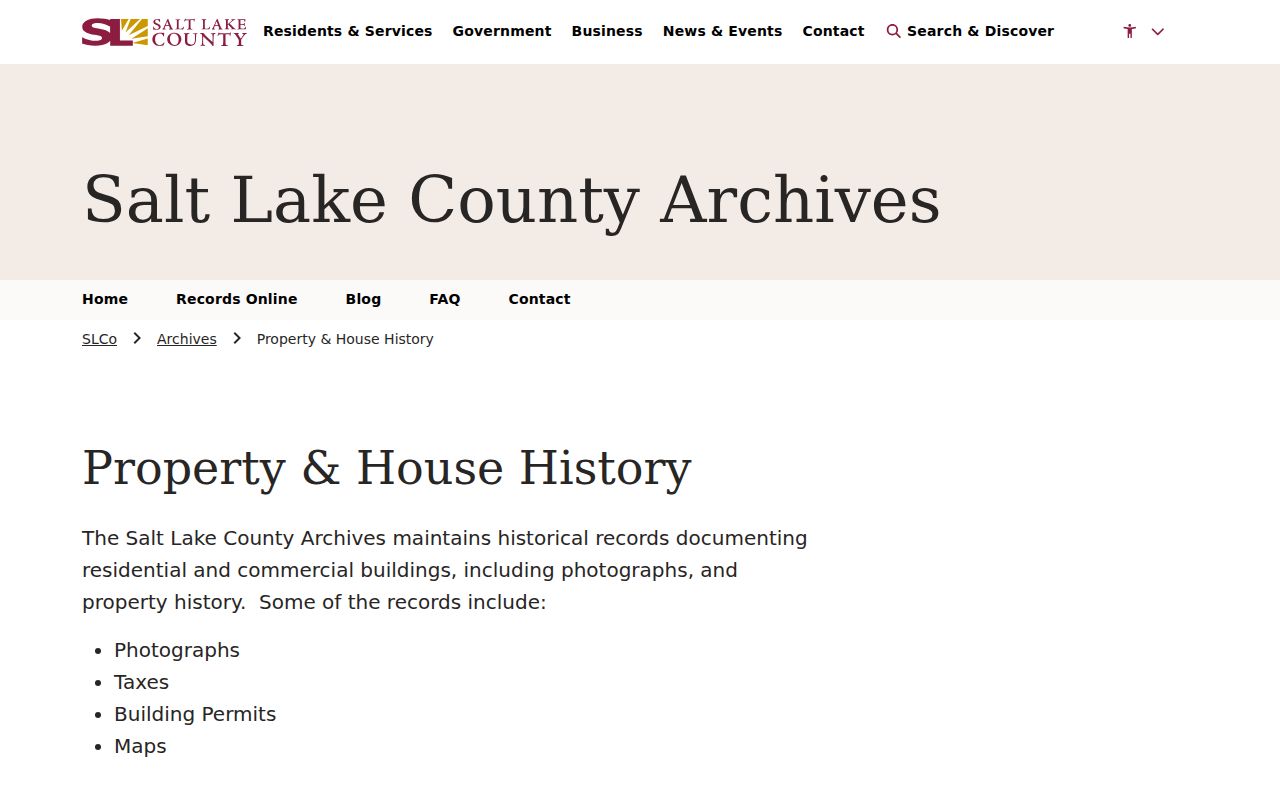
Use the card’s date and fields as property context, then seek a separate dated source for an occupant.
Midvale Land Titles Before Addresses
Land-title certificates cover 1851 through 1895, with a bulk of material from 1871 through 1873. The online surname index was described for names beginning with R, while Archives staff can check items that are not uploaded. These certificates can connect an early name to a legal description before a modern street line existed.
Utah territorial law required county grantor and grantee indexes in 1850. That history explains why an old Midvale search often moves from APN to legal description, then to plat, abstract, and name index. A title record shows an instrument or interest. It does not by itself identify a household, and it should not be rewritten as proof that a person lived at the parcel.
Maps Explain Past Midvale Places
County Archives maps and the RM-020 finding aid include C-18.2 Midvale. Sanborn maps add building footprints, use, streets, alleys, stores, churches, schools, and industrial context. The City Library and Utah Historical Society resources cover Utah town and city maps, with Sanborn material spanning 1867 through 1970 in the documented collection description.
Use a map to test whether a historic address could be the modern parcel. Pair it with a directory entry, tax card, plat, or deed. A map can show what stood next door or whether a street moved, but it is not a resident list. Record the map title, year, sheet, and holding institution.
Midvale House Stories in Layers
A responsible house story can join a 1935 directory occupant, a 1957 appraisal-card building note, a later tax-card photograph, a current APN, and a modern plat. Each source answers a separate question. The directory supplies a period name, the card supplies property context, the plat supplies land geometry, and the APN ties the modern parcel to the county system.
Leave gaps visible. If no directory entry appears, the person may have been unlisted, omitted, misspelled, outside the volume, or absent during publication. If a card is missing online, contact Archives. If a deed image is paid or unavailable, report the index fields without pretending to have read the document.
Pair Midvale Years With People
A past-resident conclusion becomes stronger when a directory, property, and life-event source agree on time and place. For example, an address in a 1935 Polk volume can be compared with a County Archives card from the same period, a newspaper notice, and a cemetery or vital-record lead. A deed can show who held an interest before or after that year, but it cannot fill every occupancy gap. Mark each row as owner, occupant, mail-to, boarder, business, or public contact only when the source uses that role.
Historical searches should also preserve negative results. A directory may not list children, renters, boarders, non-telephone households, or people whose names were abbreviated. A tax-card run may be incomplete online. A street may be indexed under Union, Union Fort, Bingham Junction, or another period label. Write down the searched year, section, address form, and source URL so another researcher can repeat the check.
When the chain stops, the next access channel depends on the record. County Archives can route offline cards, ledgers, maps, and certificates. The library can identify microfilm or database holdings. Utah’s records portal can route a state request, while Midvale’s GRAMA form can reach a city file. The custodian may report that a record is not maintained or protected. That answer is a result, not permission to fill the gap with a guess.
The same rule applies to an apparent current owner. An Assessor record can be current tax data while a directory entry describes a past occupant. Use exact phrases such as “grantee in a deed,” “owner shown on a card,” or “listed at this address in 1935.” Careful labels make previous residents research useful without overstating what the records say.
Past Households: Directories, Census, and Obituaries
Owners are only one layer of previous residents. Polk volumes can place a name in a street or householders section, and the 1931 to 1932 telephone catalog includes Midvale among adjoining towns. Search the alphabetical and address sections, then pair a publication year with census, newspaper, tax-card, or deed evidence. The Midvale city directory collections page explains the collection itself; this trail keeps the focus on one address moving backward.
Newspapers can close a household trail with an obituary, marriage notice, birth, legal notice, school activity, or organization mention. Cemetery search can narrow a same-name problem by death year and place. A directory absence can mean a move, unlisted number, variant spelling, publication gap, or incomplete volume. Record “not located in the searched source” rather than turning silence into a conclusion.
Lawful use. Previous-resident research in Midvale is for house history, family history, and personal curiosity. Do not use a historical or current address record to stalk, harass, intimidate, or track a living person.